How Often, Honestly
Every three to five years is the working answer for most households, and the spread
inside that range is not arbitrary. Two things move it:
- Tank size against household size. A 1,000-gallon septic tank is common for a
three-bedroom house. Two people in that house are filling it slowly; five people, plus a garbage
disposal, plus laundry every day, are filling it fast. Same septic tank, genuinely different schedule.
- What goes down the drain. Wipes — including every product marketed as
flushable — do not break down and are the most common avoidable cause of septic service calls.
Grease, coffee grounds and cat litter add to the sludge layer directly. Heavy bleach and antibacterial
cleaner suppress the bacteria doing the digestion.
Seasonal use changes it too, which matters in a county full of second homes and waterfront rentals.
A St. Michaels or Tilghman Island house occupied hard for three summer months and empty the rest of the
year is on a different septic clock than a year-round Easton household — and a rental that sleeps ten on
a summer weekend can put a year of ordinary load through a septic tank in a season.
If nobody can tell you when the septic tank was last pumped, the honest move is to pump it and start the
clock. What comes out tells you what interval this house actually needs.
What a Pump-Out Should Include
The truck emptying the septic tank is the easy part. What separates a service call from a transaction is
what gets looked at while the tank is open and visible — it is the only routine opportunity anyone
has to see inside your septic system:
- Both compartments emptied, not just the first one. Two-compartment septic tanks are
standard and the second chamber still fills.
- Baffles and tees checked. These keep scum from escaping to the drain field. They
corrode and break, and a missing outlet baffle sends grease straight where it must not go.
- The effluent filter cleaned, if the septic system has one. A clogged filter is a very
common cause of a slow-draining house and a very cheap fix.
- Backflow watched. If liquid runs back into the septic tank from the outlet once it's
empty, the drain field is telling you something, and you want to hear it now rather than in March.
- A plain report of what was seen. Sludge depth, septic tank condition, anything
concerning. In writing beats "you're all set."
Pumping, BAT Service and Repair Are Three Different Things
These get conflated constantly, and the confusion costs people money in both directions:
- Pumping physically removes accumulated solids. Every septic tank, conventional or BAT,
needs it every few years.
- BAT operation and maintenance is
scheduled service of the mechanical treatment components — blower, floats, alarms, control panel
— on a nitrogen-removing system. In Talbot County it is legally required under Chapter
146, performed by certified providers and logged in Maryland's tracking database. Having a BAT system
serviced does not mean the septic tank has been pumped.
- Repair is what happens when something has actually
failed — a broken line, a dead pump, a saturated field.
A BAT owner on a proper O&M contract still needs septic pump-outs. A conventional-system owner who pumps
religiously has no O&M obligation at all. Knowing which of the three you are buying is most of
knowing whether the price is fair.
When Pumping Is Not the Answer
Worth saying plainly, because the opposite gets sold. If sewage is backing up or there is a soft wet
patch over the drain field, pumping the septic tank will often stop the symptom — for a while. If the
tank was simply overdue, that is the fix and it holds. If the drain field has failed, the septic tank refills
over the following days or weeks, has nowhere to discharge, and the backup returns.
A septic pump-out every few weeks is not a maintenance plan, it is a subscription to a problem. If that is
the pattern you are in, the honest conversation is on the repair page and,
if the field is genuinely done, the replacement page —
where, in Talbot County, a failing system is
first in line for Bay Restoration Fund grant money. That is
a far better outcome than paying to empty a septic tank on repeat.
Finding the Tank, and Making Next Time Cheaper
Plenty of Talbot County homeowners have no idea where their septic tank is — especially on older
properties and houses bought in the last few years. Records at the Talbot County Health Department's
Office of Environmental Health, at 215 Bay Street in Easton, often show the original system location,
and an experienced crew can locate a septic tank on site when they don't.
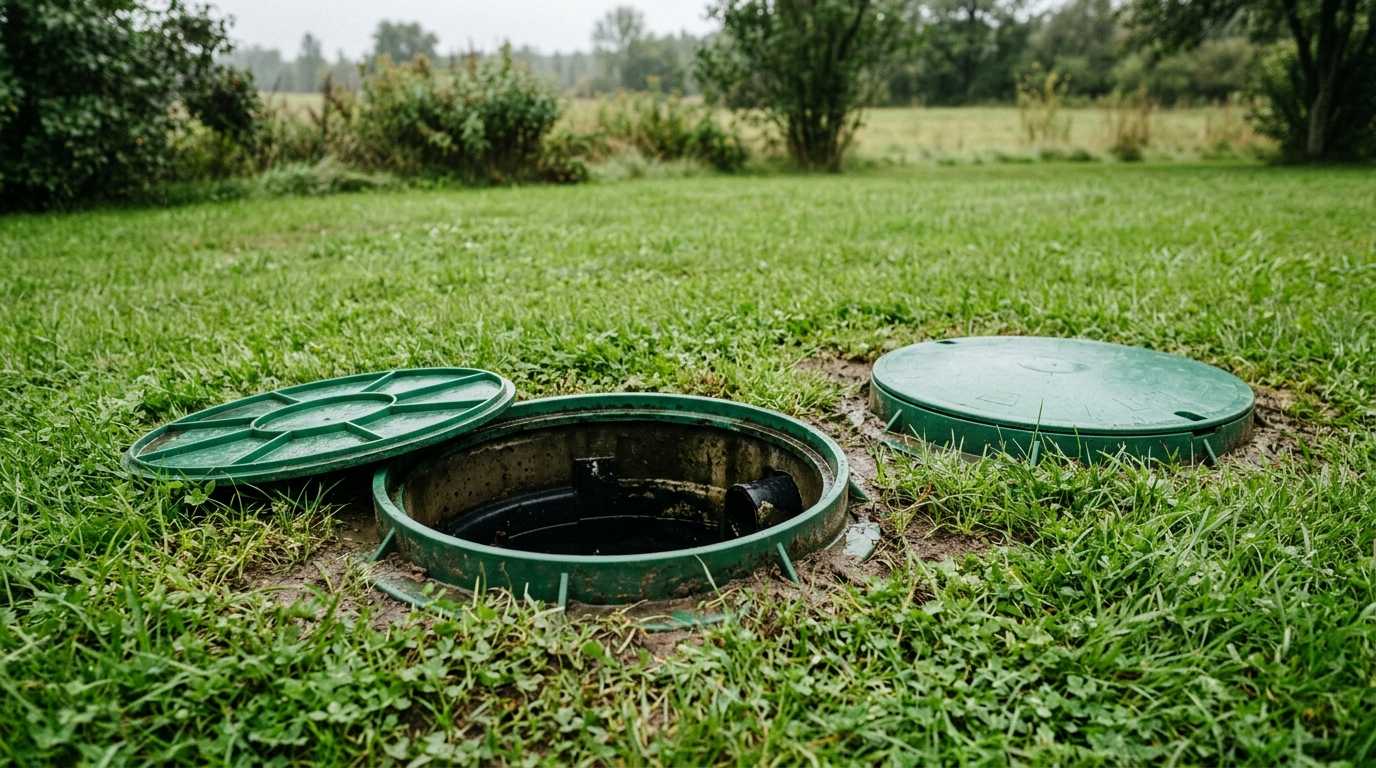
Once it's found, the single best money you can spend is on risers — access
lids brought up to ground level so the septic tank can be opened without digging. They cost something once and
remove the excavation charge from every septic pump-out and every inspection afterwards. On a septic system you plan
to own for another decade, they pay for themselves.